


At 6’5”, it is impossible not to notice Isaiah Sylvester when he walks down the hallway. But his height is not what people talk about most.
Instead, students and teachers at West Chicago identify his warmth, faith, laughter, and the way he always stops to hold a door open or help a teacher carry something heavy.
In a school of nearly 4,000 students, Isaiah stands out. Not just because of his stature, but because of his spirit.
From Trinidad to Illinois
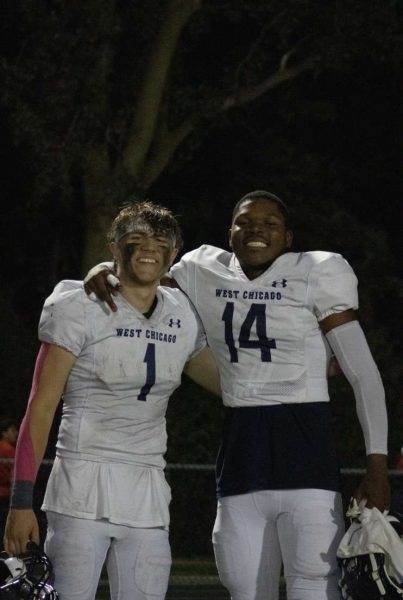
Sylvester grew up in Tobago, Trinidad, a Caribbean island known for steel drums, bright colors, and humid days split between the dry season and the rainy one. He lived there for 14 years before moving to the United States, a transition that came with equal parts excitement and challenge.
His father had been living in the States for years, and the chance for better sports opportunities made the move feel like the right decision.
“Sports here are way more competitive,” Isaiah said. “I played soccer for fourteen years, ever since I was small, but come up with America, I never play soccer, and I think that’s my fault.”
He did not solely focus on soccer. When he came to America, he fell in love with his holy trinity: “I currently play football, basketball, and am on track,” Isaiah said. “Basketball was a sport for me just to get better at on defense, if that makes sense, because of football and track. Track is something that I have always done since middle school, I want to stay on track, for the hurdles.”
The hurdles. Whether it is 55, 100, or 300, Isaiah will be on that start line. Though the physical hurdles are not the only ones Sylvester has overcome: getting to know a new school system, finding his identity, and even overcoming his injury have all made him who he is.
Adjusting to a New School System
School in the U.S. is almost unrecognizable compared to Trinidad. There, Isaiah’s days followed a strict, immovable schedule. No free periods. No wandering the halls. No late arrivals.
“We started from eight and out at three, we had an hour lunch,” Isaiah said. “Just like the outside was bigger because we had a football field, basketball court and how it was, we had an hour so we just went outside. There’s a cafeteria outside. You go, eat, sit with your friends and stuff. You just chill.”
Trinidad’s curriculum also looks different. Instead of electives like chemistry or health, Isaiah grew up studying practical skills like welding, nutrition, and social studies.
Isaiah’s younger brother, freshman Micah Sylvester, had similar experiences in Trinidad, especially in terms of the education system.
“They find better ways to teach than in Trinidad, because sometimes their work used to be confusing in Trinidad,” Micah said.
But the biggest adjustment was not the schedule or the academics: it was the language.
Culture and Religious Difference
Isaiah speaks Trinidadian Creole (or “Trini”), a broken English dialect with a rhythm and speed that can catch Americans off guard.
“Sometimes people look at me like they don’t understand what I’m saying,” he said. “I just say it slower.”
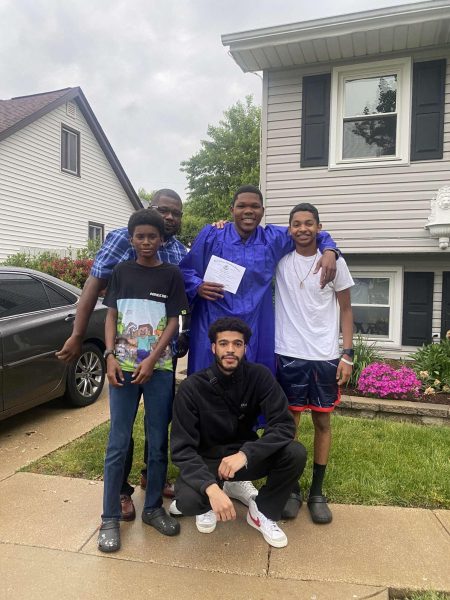
When asked to demonstrate, he delivered a few lines in Trini. It was fast, melodic, and full of personality. It was the kind of accent one would want to hear again, just to catch the music in it.
“So the Caribbean is Black people. There’s no white people in general, and there’s Indians, Muslims, Spanish people, Arabic people. But the country, Trinidad and Tobago, is just full of Indians, Muslims and black people, and a tiny bit of Spanish people,” Isaiah said. “So it would be, Hindu, Muslim, Christian, and Baptist. After that, we have the other ones that piece together with Christianity, but just a small group.”
A Gentle Giant with a Big Heart
“I’m a gentleman, if that makes sense,” Isaiah said. “Because I help, I mean, I help teachers. Teachers do a lot of stuff in the classroom. So see, if someone needs help to reach for something or open a door for them.”
His kindness, laughter, and friendliness echo through the halls.
“I just make everyone laugh. So if I see you sad, I’ll just be like, ‘Stop crying, just laugh, bro. It’s not that serious,” Isaiah said.
Isaiah’s story is still unfolding. He is still adapting, learning, and finding his place in a country that is filled with opportunity.
One thing is definitely clear: whether he is locking down a receiver on the football field, hurdling over obstacles on the track, or translating his Trini accent for a confused friend, Isaiah approaches everything with humility, humor, and heart.
And in a school full of voices, his stands out, not just because of his accent, but because of who he is.
![[HUMANS OF WEGO] Beyond the megaphone](https://wildcatchronicle.org/wp-content/uploads/2025/12/john-1200x900.png)