

He gets up early for practice, stays up late finishing homework, and spends every moment chasing a dream that grows bigger every day. The pressure to succeed – both for himself and for those who believe in him – never goes away.
The “he” in question is Kuba Slupski, a dedicated soccer player for both the school and his club team, Sockers, and a strong student with good grades and a positive, energetic personality.
Slupski’s journey begins with pressure: the pressure of being a first-generation Polish-American, the son of immigrants who arrived in the United States with little money, no connections, and nothing guaranteed. Today, he is a senior at West Chicago Community High School, a standout soccer player, and a dedicated student, but the path to success has been anything but easy.
“Growing up, not having a lot of money in our family, going from apartment to apartment… it was tough,” Slupski said.
Those early challenges shaped who he is today. His first language was Polish, and when he entered preschool, he did not understand English at all. He remembers kids talking to him while he stared back blankly, stressed.

“I’d come home crying to my mom, talking in Polish, like, ‘I don’t understand them,’ and my mom was like, ‘You have to learn,’” he said.
But soccer became a constant. Slupski has been kicking a ball since he was 18 months old and was introduced to the game by his parents, who quickly recognized his love for the sport, signing him up for teams, watching Polish matches on TV, and encouraging him to chase something bigger.
“It’s something I put 120% effort in… I go there [to the soccer field], I relax. It calms me down. It’s amazing to me,” Slupski said.
His high school career was full of highs, including West Chicago’s best season in four years. Yet he holds himself to extremely high standards – sometimes too high, he said. Still, this year stood out. The young roster pushed farther than any team he had played on before.
“It was excellent seeing how a bunch of young people like this can do great things,” he said.
Teammate Dimitry Stetsik said Slupski’s leadership shows up both during games and in everyday practice.
“Kuba is a teammate who brings the same intensity to practice as he does to a championship game,” Stetsik said. “On the field, he sets the tone for everyone. He holds himself and everyone else accountable.”
Stetsik said Slupski also pushes his teammates to stay focused when games get difficult.
“During our game against Leyden, we were down 1–0 at halftime,” Stetsik said. “Kuba kept trying to lift everyone up and saying we had more than enough time to win the game. In the end, we came back and beat them.”
Off the field, Stetsik said Slupski is someone teammates respect and enjoy being around.
“He’s an easy person to talk to and a great friend to be around,” Stetsik said. “He’s not afraid to hold people accountable when they’re doing something wrong in practice or in a game, and not a lot of players are bold enough to do that.”
West Chicago assistant soccer coach Dorian Carrasco has seen Slupski grow since his first year. He remembers Kuba coming in as a freshman with clear talent and love for the game, but says he grew in many ways beyond just soccer.
“Watching him grow over the last four years has been remarkable,” Carrasco said. “Not only did he grow as a soccer player, but he also grew mentally and emotionally.”
Carrasco said athletes are often judged only by how they play, but Slupski did a good job balancing school, soccer, and life with maturity.
“No matter how hard or easy each day seemed, Kuba managed every situation in the best way possible,” Carrasco said.
On the field, Slupski’s ability to play different roles made him important to the team. He could hold up the ball, run behind defenders, or drop back to help create chances for his teammates.
“He came into his senior year with goals to help the program reach new heights, and that’s what West Chicago soccer did,” Carrasco said. “Kuba was a joy to work with, and he’s one that we’re really proud of — and will be going to miss next year.”
But the real turning point came when he realized soccer could define his future. As college coaches started reaching out, the dream he had for so long suddenly took a big step.
“Soccer got me somewhere… committing to a college was like, wow, I really did something,” Slupski said.
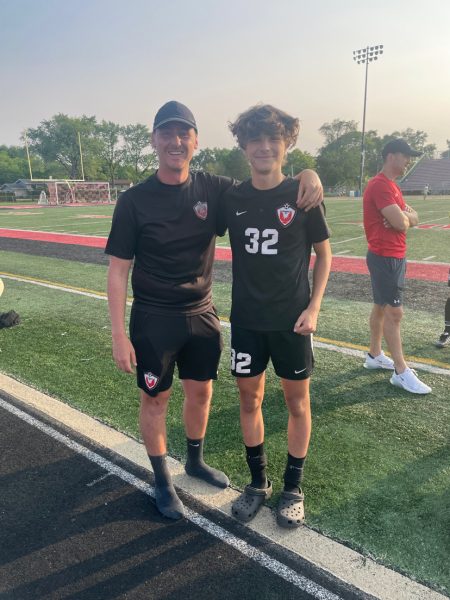
The recruitment process was not easy. With immigrant parents and no built-in connections, he had to do everything himself.
“You need connections in life, and if you don’t have it, it’s really hard… I did this myself,” he said.
Being capable of playing anywhere, but strongest at right wing, helped him stand out. Training with higher-level players humbled him but also made him better. Clubs like Firebirds and Sockers shaped his mentality, discipline, and work ethic.
“If you play happy, you play your best,” was advice from his coach that stayed with him through anxiety, pressure, and self-doubt.
Despite pressure on and off the field, Slupski always returns to work. Hard work defines him: it carried him from a childhood marked by instability to a college roster spot earned entirely through his own hustle.
“Hard work gets you places… I’m a hardworking person, always humble, and mature in understanding that,” he said.
Looking ahead, Slupski’s goals are clear: grow in college, then push toward semi-professional or professional soccer. But success, to him, is more than trophies.
“Success is when you’re happy with what you have, the people around you, the life you’re living,” Slupski said.
And he is not done. College is a new chapter – a chance to step into adulthood, stay motivated, and chase the sport that has shaped nearly every part of his identity.
“At the end of the day, if I get paid to play the sport I love… that’s all I could ask for,” Slupski said.
![[HUMANS OF WEGO] Beyond the megaphone](https://wildcatchronicle.org/wp-content/uploads/2025/12/john-1200x900.png)