


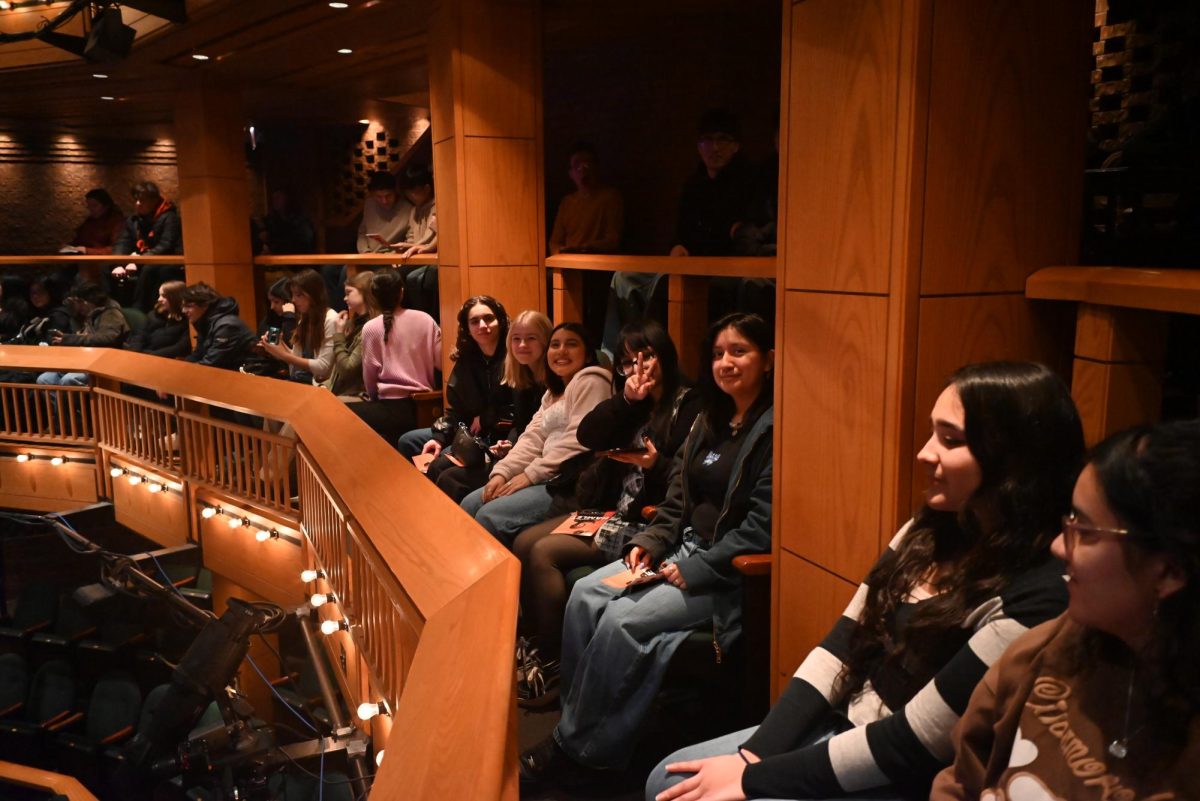
For the past nine years, students enrolled in AP English Literature and Enriched World Literature have had the chance to view an adaptation of Shakespeare’s “Hamlet.” The performance was shown by the Chicago Shakespeare Theater at Navy Pier from Jan. 31-Feb. 28. Ninety-six West Chicago students attended the event this year. A separate group of students also attended on Friday, Feb. 20, to view the performance.
“Hamlet” is one of Shakespeare’s most well-known tragedies and has been adapted and interpreted in many ways throughout history. Every year, the Chicago Shakespeare Theater performs modernized versions of several Shakespeare plays. This time, “Hamlet” was presented as a 75-minute version of the play performed specifically for student audiences.
The Chicago Shakespeare Theater adapted the play with a modernized take on the costume design, set and staging while still reciting the original script.

“I feel like it not only connected you to the play, but it connected you to everyone in the theater,” senior Ashley Garcia said.
In many productions performed at the Chicago Shakespeare Theater, the audience is engaged and can respond to the actors. Multiple times throughout the performance, actors asked the audience for input during certain scenes.
“The fact that you could answer them made it seem like you could just be comfortable and enjoy it,” Garcia said.
Before seeing the play, students watched classmates perform a mock version of scenes prepared that morning. The mock performance helped students understand the plot of “Hamlet” and what drives the characters.
Students then took buses to downtown Chicago and ate lunch at the shops at Navy Pier before viewing the performance.
In this adaptation, actors were able to portray their characters with ease and much of the audience was able to connect with the characters more. Through the setting of downtown Chicago and the costumes being unique to each character, the actors noted that the personality of each character was captured more than historically accurate costumes would.

“They made it perfectly modern, in a way that we could laugh about it comically,” Garcia said.
After the performance, a Q & A session was held for the students to ask each of the actors any question, some asking about the slight changes in scenes and others about why Horacio was not included.
Students who did not attend the performance read and analyzed soliloquies excerpted from Shakespeare’s “Richard III” during class time. In the end, many students who watched the play relished being able to see such a performance live as opposed to reading the play during class time.
“A lot of students would not decide on their own to go see a Shakespeare play, so I think this trip opens up students to something that they wouldn’t always go to themselves,” English teacher Kelsey Wirkus said.
This method of teaching Shakespeare and breaking down his use of iambic pentameter has proven to be effective and engaging for many students.
“It’s always to have them see literature and English in a whole other way that I just cannot replicate in the classroom, because all plays are meant to be seen and performed,” Wirkus said.


