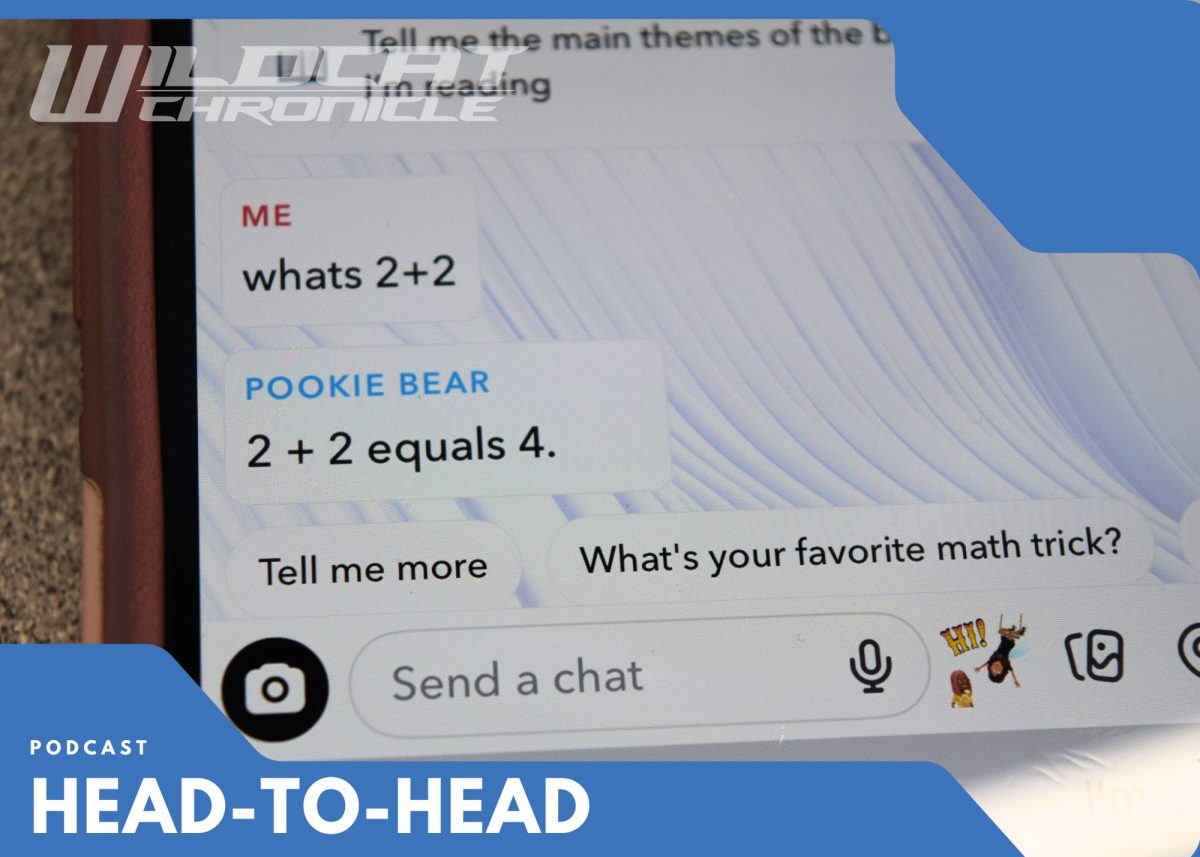

“Head-to-Head” is the Wildcat Chronicle’s student-led audio debate series where two Chroniclers take opposing sides on a timely issue affecting the West Chicago Community High School student body and beyond. Each episode features research-backed arguments, personal perspective, and respectful back-and-forth discussion — leaving listeners to decide where they stand.
The goal isn’t to “win.” It’s to think critically, listen carefully, and engage with ideas from multiple viewpoints.
Prefer reading? A transcript of the episode is below.
Ritwik Jalota:
Hello. My name is Ritwik Jalota, and me and David will be debating today’s topic: are cell phones ruining today’s society? David will be arguing the side that cell phones are indeed harmful, and I will be arguing that they are not.
To start off, I would like to say that the majority of countries say that phone use has a very positive impact on education because of the development of study tools and just overall good influence for students. From my article, Pew Research — David, what would you like to say?
David Weber:
So first of all, I think that yes, there are good things that phones bring to education, obviously with study tools specifically. But I will also say that in another study done at the University of British Columbia, this guy named Kostadin Kushlev found that cell phones have harmed social relationships, relationships with parents, and the ability to form relationships.
School is one of, if not the biggest, ways to make relationships with people early on in life. It helps build those building blocks that you need in life. So I would argue that it’s better to not have phones in those areas of life because building those relationships early on is crucial for someone to really do well in life in general.
Ritwik Jalota:
Yeah, I see where you’re coming from, David, for sure. But I would like to move on from that to a University of the People article I found. Cell phones allow you to do so much on the go, which can save you time with endless applications and the ability to communicate via different platforms, send photos — you can get a lot done with nothing more than one powerful device.
Social networking apps have changed how people make friends, maintain friendships, and share memories. That’s what I see in contrast to your point before, because you say that there are a lot of negative things going on, but I’m also seeing a lot of social networking happening.
David Weber:
Yeah, I do see that. I think they definitely help build relationships in some ways, but I think that in some arguably more crucial ways — in my opinion — they hurt people’s abilities to form relationships.
Another thing, which is not psychological but more physical, is that cell phones have been shown to cause up to three to four times more traffic accidents. That’s obviously because people are distracted driving, but that also goes along with attention span. People’s attention spans aren’t as long because they’re on their phones so much.
When they’re driving and they hear something from their phone or see something on their phone, they completely shift their attention from the road to their phone, and that obviously causes more accidents. Even outside of the car, attention span is a really important part of life. If you’re in a business meeting and you miss an important part of a presentation because you’re looking at your phone, that could be a big problem.
My final piece is that cell phones have been shown to cause an increase in dozens of psychological effects that are generally negative. This was reported by Medical News Today. Some of the issues are depression, anxiety, and low self-esteem.
A lot of that stems from social media, which is accessed through phones. You see so many different parts of life that you can’t be part of. If you see all this negative stuff online, it’s going to make you not enjoy life as much or feel as happy. I know that when I see people I know and see negative stuff online, it definitely makes me not as happy.
Self-esteem is one thing that’s been really hurt by social media because you see people who look “perfect,” but it’s really just that they’re perfect on social media. Even if they are similar in real life, that’s the top one percent. I think that’s one really big issue caused by this.
Ritwik Jalota:
Yeah, just to respond to your first point about accidents happening, I firmly believe that it’s not really the cell phones causing them — it’s more the people. You should not be distracted when you’re driving. I feel like it’s more of the person’s fault than the technology’s fault.
To your point about social media causing depression and self-esteem issues — yeah, I agree. When I see people having a perfect life, it can make me feel bad about mine. But there are also so many apps that can help with mental health. There are sleep apps and other tools that help with anxiety and depression.
Now on to my final point: more than 90% of cell phone users report that owning a cell phone makes them feel safer. You can have emergency contacts, emergency helplines, suicide prevention lines — all of that on your phone. That’s why I feel like having your phone is actually a safety measure. There are a lot more precautions set up to make them safe.
That’s all I have to say today.
David Weber:
That’s a really great point, Ritwik. But we’re going to wrap this up. This is going to be it for this episode of “Head-to-Head.” Thanks for tuning in, and we will see you guys next time.
Ritwik Jalota:
Thank you.
Transcribed by Otter.ai.