


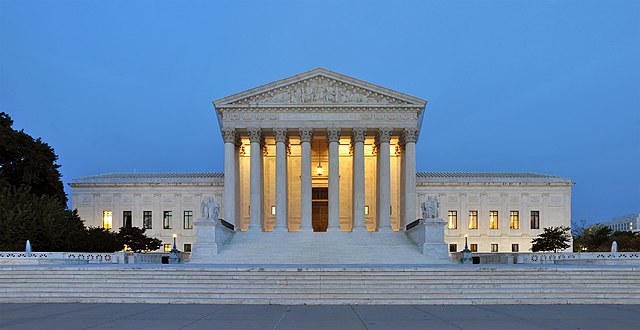
In Idaho and West Virginia, transgender athletes have challenged state laws restricting participation in school sports. These lawsuits, originally filed in 2020 and 2021, have reached the Supreme Court, raising broader questions about state authority and federal protections for transgender youth.
In 2021, Becky Pepper-Jackson of West Virginia sued her middle school after being barred from joining girls’ sports teams.
Pepper-Jackson, a track athlete who now competes in shot put and discus in high school, argues that because she took puberty-blocking medication, she does not have a competitive advantage in her sport. Her case, West Virginia v. B.P.J., could affect whether middle school and high school students are permitted to compete in sports consistent with their gender identity.
“In this case, before the Supreme Court, the transgender athletes are arguing that the law that prevents them from playing a sport as a gender they identify goes against the 14th Amendment,” Candace Fikis, government teacher at West Chicago Community High School, said. “Yet, those who support the ban believe it is unfair to athletes who identify as their birth gender, and it protects the common good of the other athletes.”
The Idaho case involves Lindsay Hecox, a Boise State University student who sued the state in 2020 after being barred from competing on women’s athletic teams. After failing to make the women’s track and cross-country teams, Hecox joined a women’s running club and soccer program before filing suit, arguing the law violated the Equal Protection Clause of the Fourteenth Amendment.
According to Cornell Law School, the Equal Protection Clause prohibits the government from treating individuals differently without sufficient justification and guarantees equal protection under the law regardless of race, gender, or other characteristics.
In September, Hecox said she would not compete in women’s sports since she took testosterone suppressors and estrogen treatment. She said she wanted to remove herself from this case because it would distract her from her academics, and she planned to graduate in May. Despite the request, the Supreme Court has continued reviewing the case and has not issued a final decision.
Twenty-seven states have enacted laws restricting transgender athletes’ participation in sports; Illinois is not one of them.
What will this mean for Illinois sports?
Illinois allows transgender athletes to compete under the Illinois Human Rights Act, which prohibits discrimination based on gender identity.
“I don’t think it will [impact the state],” AP U.S history and government teacher at West Chicago Community High School John Chisholm said. “Illinois is a blue state, and democrats tend to be in favor of transgender rights, so I think it wouldn’t impact our state.”
The Supreme Court heard oral arguments in the Idaho and West Virginia cases on Jan. 13, in Little v. Hecox and West Virginia v. B.P.J., which challenge state laws that bar transgender girls and women from participating on female sports teams. According to Amy Howe of the ScotusBlog, the justices spent more than three hours questioning attorneys on both sides of the issue. Some media analysis of the oral arguments noted that a majority of justices appeared inclined to uphold the state laws, though no final decision has been issued and the outcomes remain uncertain. Decisions in these cases are expected later this term.
According to The Hill, National College Athletic Association (NCAA) President Charlie Baker told a U.S. Senate panel that there are fewer than ten openly transgender athletes among more than 500,000 student-athletes nationwide.
Legal experts say these cases could shape how participation and eligibility are defined in the future.
“In competitive athletics, winning and performance may be more visible, but participation still plays a foundational role, in my opinion,” a West Chicago student who wished to remain anonymous said. “Rather than viewing participation and competition as opposites, I think they work best when balanced, giving students opportunities to grow, challenge themselves, and feel valued regardless of skill level.”
Revision
Jan. 18, 2026
This article was revised to improve clarity and attribution, remove speculative phrasing, and update sourcing related to Supreme Court proceedings. An accompanying photo was also removed. The substance of the reporting remains unchanged.


