



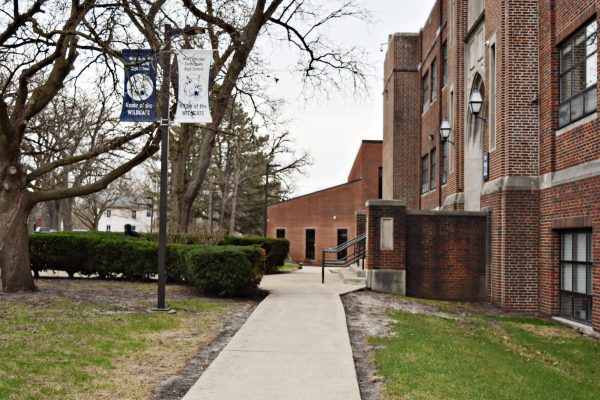
Clean blue and gray lines mark the structure of Entrance One at West Chicago Community High School. Poles are arrayed in a line across the freshly shaved grass leading to Entrance One.
Within the past few years, WeGo has made numerous additions, removals, and renovations to spaces. Such spaces include the addition to Entrance One, renovation of the arcade, and the removal of the second greenhouse, along with the addition of a transition apartment.
“We have two sides to the building. We have the traditional front, which I love, with all the big trees out there. And then you have the new front, which is modern and glass,” Horticulture Teacher Corrie Stieglitz said.
In recent years, greenery and green spaces have been sacrificed for additions to the building for the expanding needs of the students.
Although the removal of these spaces might have proven less beneficial to the students of WeGo. Decades ago, many spaces were open for students to go outside and enjoy the greenery on campus. Students were able to sit outside in the arcade and eat lunch, enjoying nature and the abundant greenery that WeGo had to offer.
During these projects, the school has removed nearly all greenery from the front entrances of the school, including the removal of Amanda Meiborg’s memorial tree in 2019, along with many other trees and plant life along the western entrances.
But perhaps the school needs to bring back the greenery it once included on campus.
Being outside and surrounded by plentiful greenery lowers stress. Students who have access to the outdoors during their day and are surrounded by trees and shrubs experience lower cortisol levels, which is the main chemical for regulating stress levels in the body. Studies from the National College Health Assessment have shown that 20% of students suffer from severe psychological distress and symptoms of depression. Many high schools and colleges across the U.S. found that adding greenery and plant life around the school reduced anxiety, offering a mental break from the routine of modern life.
Not only this, but the addition of greenery boosts mood and productivity. The atmosphere of natural sounds, sights, and fresh air while eating lunch or doing homework has shown an increase in efficiency in getting activities done. The addition of more greenery increases the amount of fresh air outside. With more fresh air, the amount of serotonin released in the brain when outside can be enhanced, elevating one’s mood.
Finally, green space fosters a sense of belonging at school. As time goes by, fewer and fewer students at high schools and colleges feel as though they belong in their current school environment. Part of this lack of belonging or isolation is due to the physical environment of schools. Psychology studies show that less structured and more colorful environments promote a stronger sense of belonging and self-expression. The color green, especially, is associated with a balance in emotional regulation between warm and cool tones, and can create a more welcoming school environment.
Although, the addition of greenery would require time and energy if the school were to invest in it. Plants require constant maintenance: watering, trimming, and regulation of growth into the summer. The school would require additional staffing to tend to plants and greenery.
“We do our best to consider the funding, the staffing, logistics of the building, and the overall atmosphere that we want to have for our students. And if it logistically works, then we try to incorporate that,” Executive Director of Business Services Dan Oberg said.
The conflict with growth seasons and the school year must be taken into consideration as well. Different species of plants have different needs and growth seasons. Stieglitz and Oberg considered having horticulture students plant different species of flora on campus, but this would be halted by the differing growth seasons of plants.
Perhaps the addition of greenery is worth the investment. The additional costs of maintenance may be worth the reduced anxiety, increased productivity, and boosted mood that would result from the addition of greenery.
“Maybe now is the time to decorate the arcade and have green spaces,” Stieglitz said.