

[IN-DEPTH] Redefining success



Psychologically, success is usually measured by chemicals like serotonin and dopamine that are released in your brain when you achieve something. By using problem solving techniques and critical thinking, it is actually possible for your brain to create new pathways that enables adaptation and habitual practices.
“You can teach your brain to learn new things and learn new pathways called neuroplasticity. So there’s a lot going on when somebody succeeds, right? So when you think about somebody that succeeded, they actually were learning new pathways and problem solving,” school psychologist Karen Szot said.
Although there is a tipping point when stress and competition are unhealthy, it has also proven to be a motivating factor, promoting resilience and personal growth.
“So stress is not always a bad thing, and I think biologically, I think it really does help you get motivated.I think there’s a tipping point too. I think if it’s too much, then you start to shut down and you’re not able to reach your goal,” Szot said. “So, if you can manage that and kind of do some check ins and some reflecting, then you can learn coping skills that help regulate stress.”

The feeling of achieving a perfect score on a test. The satisfaction of a promotion. The relief and sense of accomplishment after getting accepted into a dream school. The pride after winning a championship for one’s sports team. All ideas that society views as “successful.”
Success, by definition, is to overcome an obstacle or hardship and to accomplish a desired goal. Although “nothing worthwhile is accomplished without hard work,” as Plato, the father of philosophy, said, people today often become so focused on what others achieve that they lose sight of their own purpose.
Throughout history, the idea of communalism and teamwork was an essential part to the structure of societies. As time progressed, the values of independence and self-reliance emerged, resulting in collectivism and helping others viewed as a weakness.
“I think older societies in large part were more concerned with the communal value of things, as opposed to the individual bottom line, whether it be money or status. Our modern society has made it so we don’t have to be as communal or our basic needs are met without having to be participatory members of our community,” Caltigirone said
As independence replaced collaboration, success became less about shared progress and more about personal gain – a shift that continues to define modern culture.
A different perspective that also exposes the rigid societal expectations is the pressure put on women to either have a successful job or stay at home. On one hand, women can view success as having a high paying job and being self-dependent while others just dream of having a simple life as a stay at home mom or wife. This contrast reveals how outdated and narrow definitions of “success” can alienate people whose goals differ from cultural norms.
The pressure to conform — whether through career ambition or domestic roles — shows how easily success becomes another way to measure worth instead of happiness.
As societies continue to change and are made up of individual people, it is important to not have exclusive ideas of what success looks like and enforce those ideas.
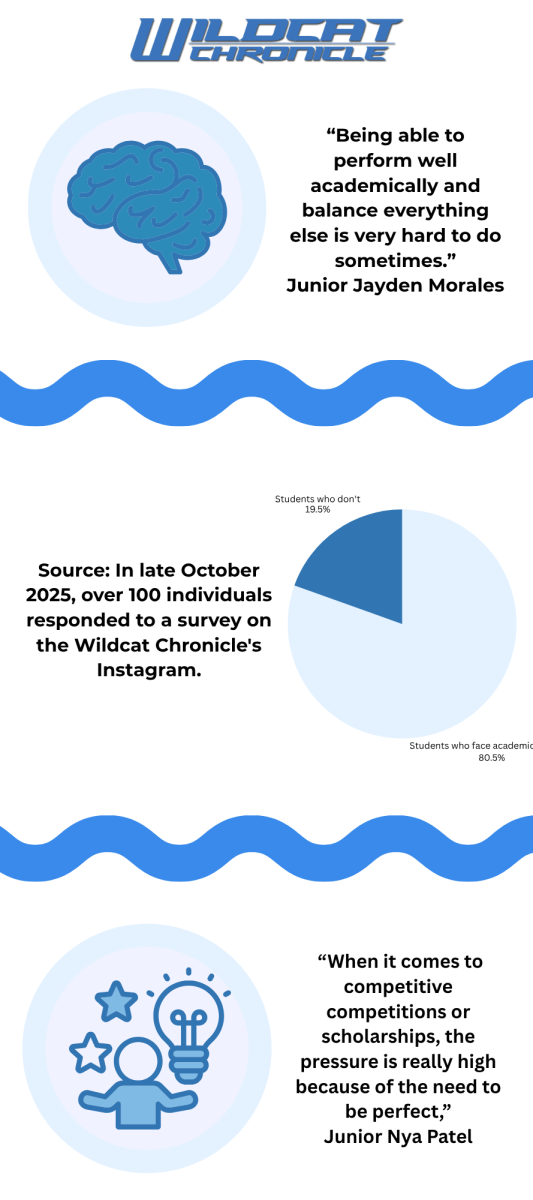
In Gen Z, another problem has also emerged because of pressures to succeed academically or athletically: perfectionism.
Perfectionism is a personality trait that is defined as the pursuit of excellence and the setting of unrealistic standards. According to the Harvard University Academic Research Center, there are three types of perfectionism: socially prescribed, self oriented, and other oriented perfectionism.
Socially prescribed perfectionism is generally interpreted as the societal expectations set in place for students and high demands like AP classes or athletic performances. Other oriented perfectionism is the belief of setting unrealistic standards for other people, and expecting those same standards in return. Both can take a serious toll on mental health.
On the contrary, self-oriented perfectionism is often one’s own motivated pressures and expectations to succeed. These are usually type A students who always get good grades, have organized schedules, and strive to become the best version of themselves.
“My academic goals are completely mine. I do know that some people find that hard to believe but really, I set most of these high expectations for myself, especially since high school has started,” West Chicago Community High School junior Niyah Patel said. “I recognize that they are very high but I’m just pushing myself to the max.”
Although academic performance is an important aspect of life, Patel has learned the importance of balance and finding fulfillment in other ways.
“On a materialistic level, I obviously see success as being the best I can at my job. Whether it’s supporting my family, or having a strong, stable life. Even though I care about these things, I know I will see true success when I see the better version of myself as a student, athlete, older sister, daughter, friend, mentor, and most importantly, as a human being,” Patel said.
Patel’s mindset reflects a shift among many Gen Z students – a generation realizing that achievement without balance leads to burnout rather than satisfaction.
A meta-analysis by the American Psychological Association, which examined 246 studies involving 41,000 college students across the United States, Canada, and the United Kingdom, found that perfectionism is at an all-time high.
According to Emily Sohn of the American Psychological Association, “Socially prescribed perfectionism spiked most dramatically, showing a 33% increase over the study period. That was more than double the 10% increase seen in self-oriented perfectionism and the 16% rise in other-oriented perfectionism, the researchers found.”
The steady rise in socially prescribed perfectionism mirrors an era dominated by social media and academic competition, where public success often feels like a requirement instead of a goal.

As the idea of success continues to change over time, it’s essential to practice methods that are rewarding and strategic, while remembering that society’s idea of achievement should not be tied to anyone’s identity or self-worth.
“I think practicing the growth mindset is a great place to start because it involves problem solving and critical thinking. You have to be able to be creative and realize when things are not working. Another key to being successful is the ability to set short term goals to be able to reach your ultimate goal,” Szot said.
In the end, redefining success may start with perspective: seeing growth as progress, not perfection. For Gen Z, that shift could mark the difference between exhaustion and fulfillment.
Your donation will support the student journalists of West Chicago Community High School. Your contribution will help us cover our annual website hosting costs. We appreciate your support!