


Special thanks to Miley Pegg for her help with this article.
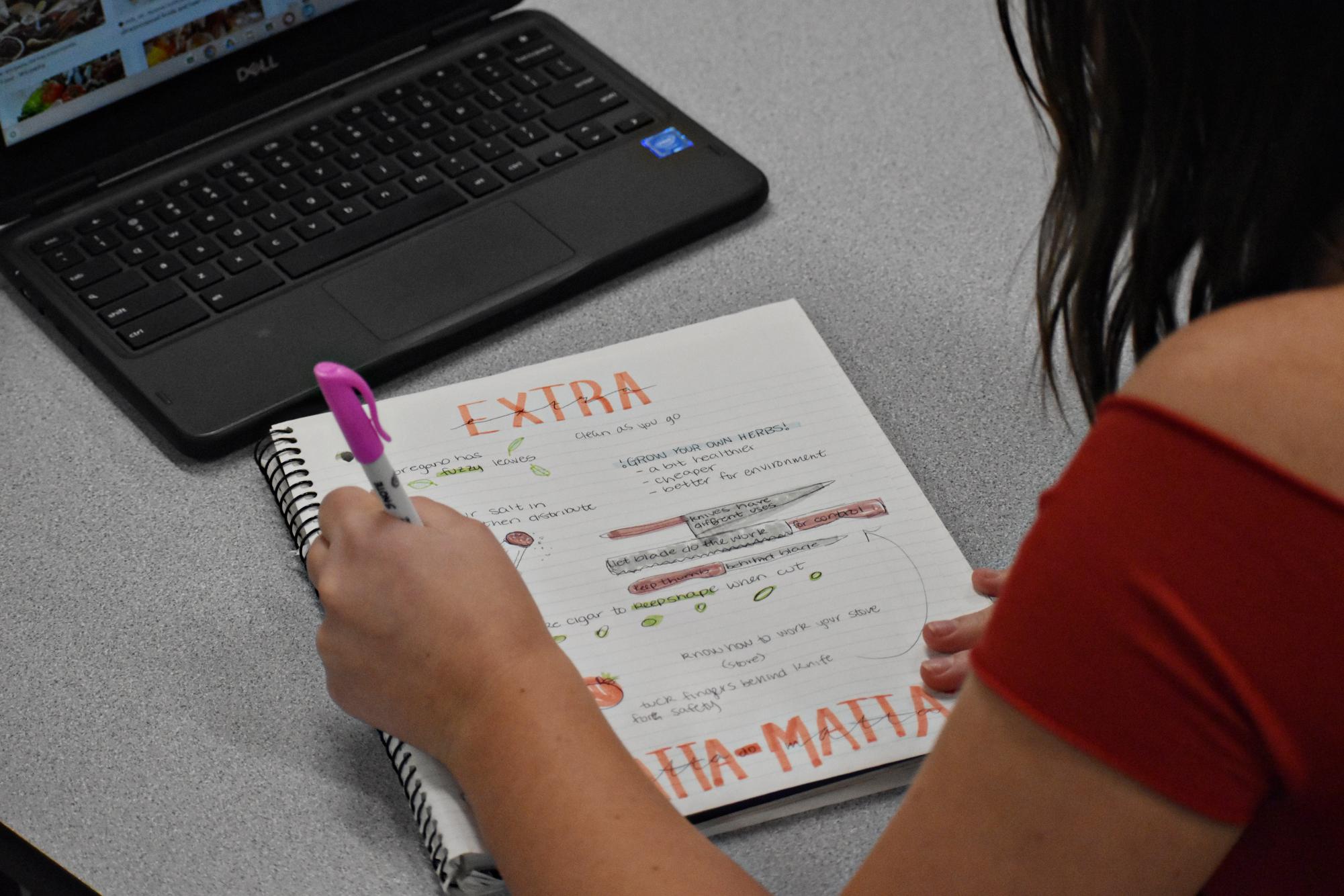
Many students receive their education in crowded buildings and loud classrooms, while others log in from home, sharpening their education in a familiar atmosphere.
Homeschooling in the United States has surged in recent years, with more families turning to flexible, at-home learning instead of traditional classrooms. According to Angela Watson of the Johns Hopkins University School of Education’s Homeschool Hub, homeschooling “continued to grow across the United States” during the 2024–2025 school year, increasing at an average rate of 5.4%, nearly three times the pre-pandemic growth rate. More than a third of states with available data are reporting their highest homeschooling numbers ever.
National surveys show that enrollment has grown since the pandemic, and local students say the change offers both opportunities and challenges. Many families say they appreciate the flexibility, which allows students to build schedules around their goals, sports, jobs, and family life.
Flexibility and time management
For Dimitri Stetsik, a homeschooled student and captain of his soccer team, the schedule is a major advantage.
“Locking in before games, because homeschooling usually only takes two to four hours. It does help with mental health and time management, but I’m also fifty-fifty about homeschooling. I get to sleep in more, but in public school, I get to see my friends,” Stetsik said.
Homeschooling allows students to design a schedule that fits their routine. Students passionate about sports or activities can schedule extra practice without falling behind in academics. Supporters argue that this flexibility allows students not just to keep up but to thrive and sharpen personal skills.
“It was really my choice,” Stetsik said. “I felt like my management was the best. I can finish my schoolwork, and I can finish my things on time and do the things I enjoy the most. Overall, being homeschooled is a game-changer.”

Homeschooling allows students to design a schedule that fits their routine. Students passionate about sports or activities schedule extra practice without falling behind in academics. Supporters argue that this flexibility allows students not just to keep up but to thrive, by giving them more time to sharpen personal skills.
Why families choose homeschooling
Motivations vary widely. When asked whether concerns about “peer pressure, the safety of their children, and religious beliefs” often play a role, Stetsik agreed: “Yeah, I’d say it’s pretty accurate.”
Longtime West Chicago homeschool educator Janet Culloton, who has homeschooled her own nine children and now teaches more than 30 additional students, says she has seen families turn to homeschooling for both practical and philosophical reasons.
Culloton explained that while she began homeschooling after disagreements over kindergarten placement, her reasons have evolved as public education has changed.
“My goals are to train up children to know, love, and serve God, to develop and practice the virtues, to teach them how to think, not just spit answers back,” she wrote via email. Many of the families she works with, she says, seek an environment that is calmer, safer, and more individualized than a traditional school setting.
She also believes the model supports academic growth, especially for students who struggled in public school environments.
“I have found, especially after homeschooling full-time many troubled kids from WeGo, that by focusing on…God, character, service, [and] thinking, academics improve dramatically—even though that isn’t my purpose,” she said.
Culloton noted that her students – some coping with trauma, learning gaps, or major life changes – often become engaged and successful in subjects ranging from philosophy to college-level biology and chemistry.
A different approach to curriculum and technology
While many modern homeschool programs incorporate online tools, Culloton runs what she calls an “old-fashioned blab school,” without screens or devices during the school day. She cites research on the effects of screens on attention, arguing that technology-free instruction encourages deeper concentration and independent thinking.
“There are now twenty years’ worth of data showing that screens have great detrimental effects on all children,” she said. Her students, who range in age from second grade to high school, adjust quickly: “The biggest adjustment…is that they are not allowed to have their phones at school and that I do not have a single screen up and running during the full 7 1/2 hour day.”
Culloton says she teaches mixed-age groups, which she believes strengthens academics and social skills alike. Students work at their own pace, with the option to slow down for mastery or accelerate if they are ahead. She lists additional benefits such as stronger sibling relationships, integrated family life, freedom to travel, and protection from negative social dynamics like bullying or cliques.
Academic and personal outcomes
According to Culloton, the results have been overwhelmingly positive for her students, both her children and those who joined her after struggling elsewhere.
“All eight of my graduated kids received college scholarships and earned magna or summa cum laude degrees…even my bonus kids…have received college scholarships, entered the work force, [or] are officers in the US Air Force,” she said.
While her approach is rooted in faith and service, Culloton emphasizes that homeschooling has become a “healing place” for many families whose children need a different environment.
The broader picture
National surveys echo these themes.
According to the Pew Research Center, many families cite homeschooling as a way to create a safe and supportive environment for their children. Peer pressure at traditional schools can be a concern, and for some, religion plays a central role in the curriculum.
As homeschooling continues to rise in Illinois and across the country, families’ experiences vary widely. For some, the structure and social atmosphere of public school remain essential. For others, the flexibility and individualized nature of homeschooling offer a healthier or more productive path.
Regardless of approach, the core question remains the same: which learning environment helps each student thrive?